Welcome to Raperport.com. This page traces the origins and journey of the Raperport name — an uncommon spelling that belongs to one of the most storied surname families in Ashkenazi Jewish history. Whether you carry the name yourself, married into it, or arrived here chasing a branch of your family tree, the story below offers a starting point for the centuries of history behind those nine letters.
A Name with Many Faces§
Raperport is one of a constellation of related spellings that share a common root. You will find the same family name written as Rappaport, Rapoport, Rapaport, Rappoport, Rapport, Rapperport, Rappert, Rapiport, Rappeport, Rapeport, Rapaporte, Rappaporte, Rapoporte, Rappapport, Rapapport, Reppaport, Repaport, Rappoporte, Rapoporto, and Rappaporto, alongside the original hyphenated forms Rapa-Porto and Rappa-Porto from which the modern names descend, among many others. The variations arose because the name travelled across many countries and many languages — German, Italian, Yiddish, Polish, Russian, English — and each transcription left its own fingerprint. Border crossings, immigration clerks, and the simple realities of handwritten records did the rest.
Despite the spelling differences, genealogists generally treat these forms as members of a single extended family of surnames, even if they no longer share a single male ancestor. DNA studies on bearers of the various spellings have confirmed that several distinct lineages have come to share the name over the centuries, often through adoption of a prestigious surname or through descent through the female line.
Origins: The Rhine, the Raven, and Renaissance Italy§
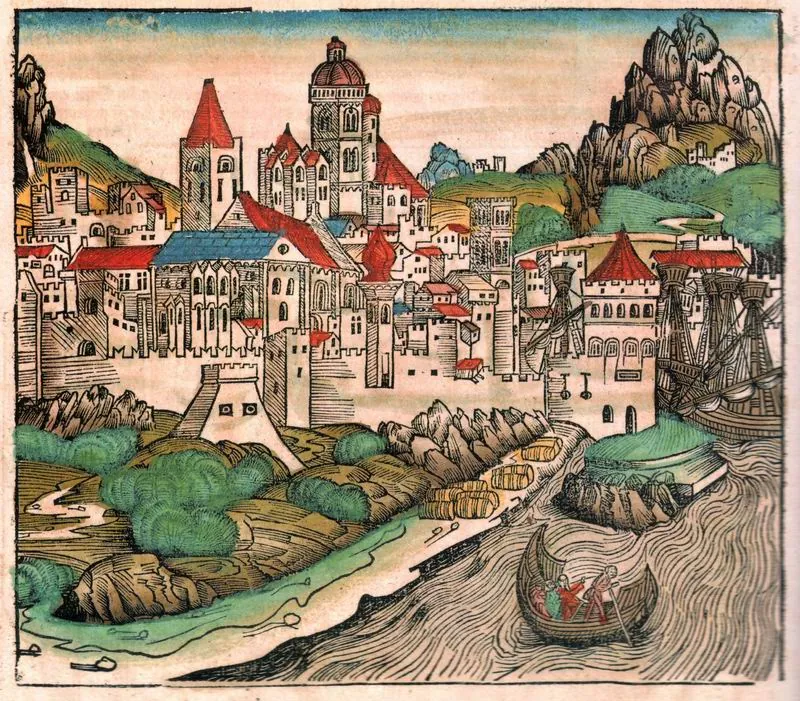
The earliest documented ancestor of the family is Meshullam Kusi Jekuthiel Rapa ha-Kohen, who is recorded in the mid-15th century along the Rhine — most likely in or near the city of Mainz. Following the expulsion of the Jews from Mainz in 1462, the family disappeared from the German records and resurfaced a short time later in northern Italy.
By 1467, a wealthy member of the family, Hayyim Rappe, was active in Mestre, near Venice, where he served as a collector of charity for the Jewish community of the Holy Land. By 1475, a Dr. Moses Rap was prominent enough in Venice to be exempted from wearing the Jewish badge required of his neighbours. The family had clearly arrived, and arrived well.
The element Rapa (or Rappe) has two plausible origins. The most widely cited derives the name from the Middle High German Rappe, meaning a raven — a connection reinforced by the bird that has appeared on the family coat of arms ever since. A second tradition, recorded in some rabbinic sources, links it to the Hebrew rofeh, meaning physician, which would befit the medical profession that several early bearers practised.
The Town of Porto§
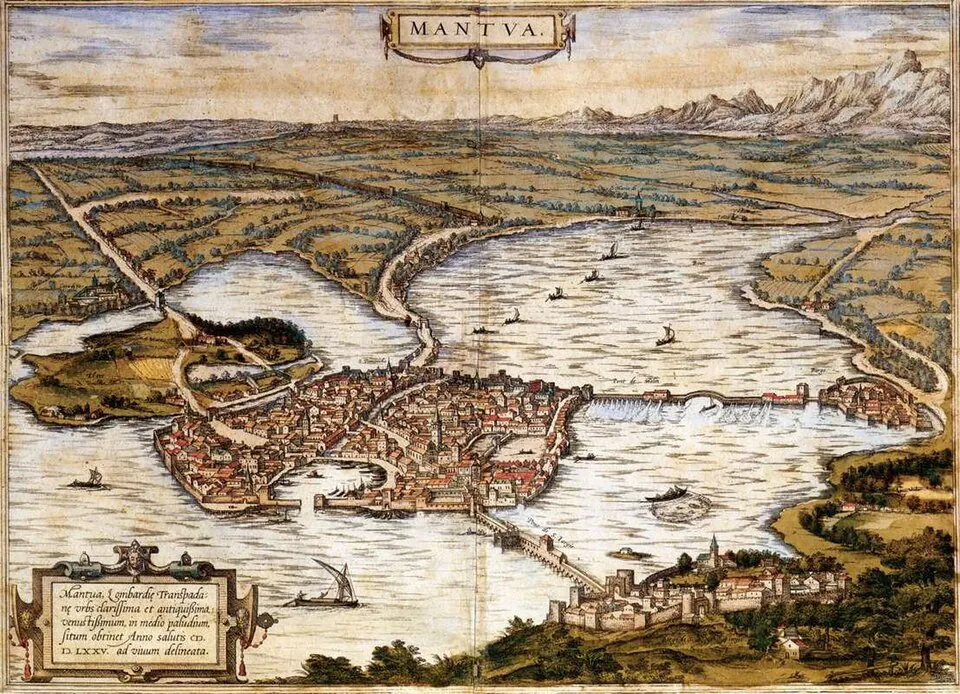
The second half of the name comes from a small town in the province of Mantua, in Lombardy, Italy — Porto, today usually called Porto Mantovano. This is a point worth emphasising, because the surname is sometimes mistakenly traced to Oporto in Portugal or to Fürth in Bavaria. The Italian Porto, set on the lakes south of Lake Garda, is the true source.
In 1540, a Rabbi Isaac Porto ha-Kohen received permission from the Duke of Mantua to build an Ashkenazi synagogue there, and the Porto family took its name from the town. A generation later, a marriage alliance — or, by another account, a deliberate act of distinction by one prominent rabbi — combined the two surnames into a single hyphenated form: Rapa-Porto, which over time fused into Rapoport, Rappaport, and ultimately Raperport.
The most influential figure of this Italian period was Rabbi Abraham Menahem ben Jacob ha-Kohen Rapa of Porto (d. 1596). A scholar, physician, proofreader of Hebrew books in Venice, and rabbi of Cremona, he was the author of Minhah Belulah, a commentary on the Pentateuch, and several other works. He witnessed the burning of the Talmud in Italy in 1553 following a papal decree, and observed the anniversary as a personal fast for the rest of his life. It was largely through his branch of the family that the combined surname became fixed.
A Priestly Lineage§
The Raperport family belongs historically to the Kohanim — the priestly clan in Jewish tradition, descended by patrilineal line from Aaron, brother of Moses. Kohanim retain ceremonial roles in the synagogue to this day, including the priestly blessing performed with hands raised in a distinctive gesture.
This priestly identity is a defining feature of the family's historical self-understanding, although it is important to note that not every modern Raperport will be a Kohen. Over the centuries the name was sometimes adopted, inherited through women, or taken by families seeking to associate themselves with its rabbinic prestige. So while the Kohenite tradition runs strongly through the family's history, individual lines vary.
Spreading Across Europe§
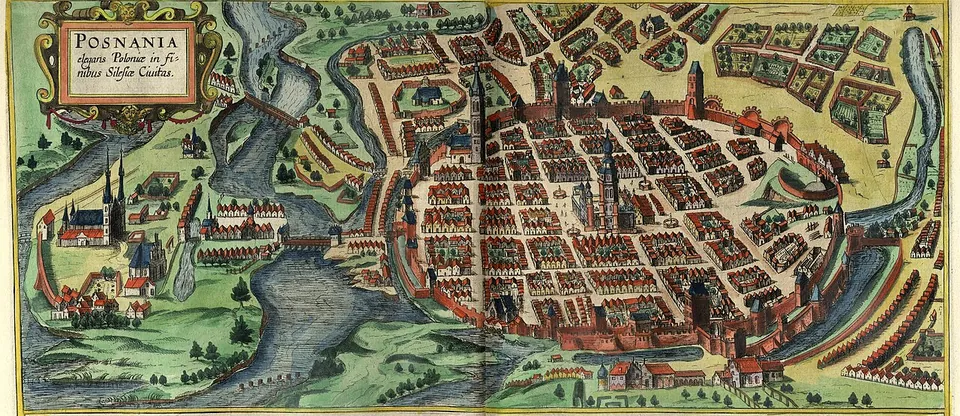
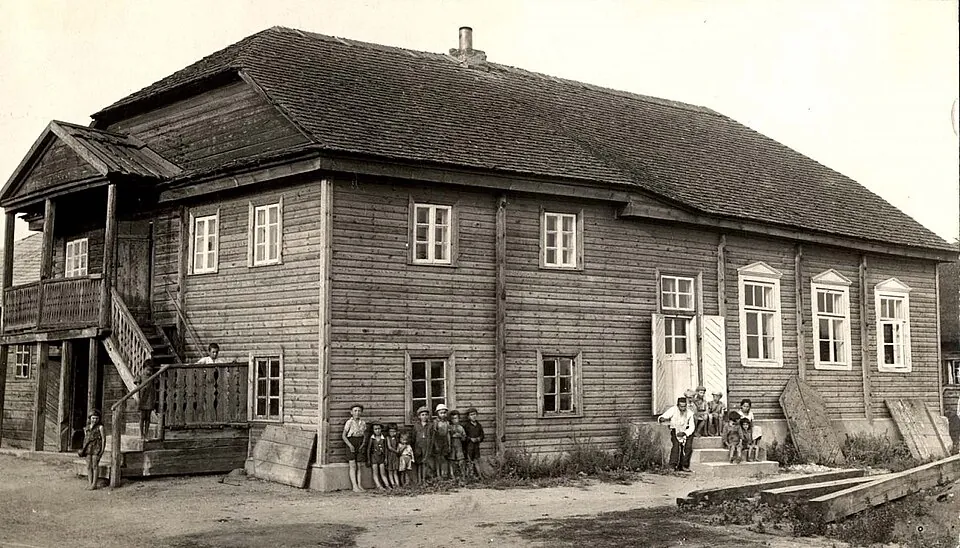
From its 16th-century centre in Italy, the family scattered. Branches moved north into Germany, then east into Poland, Lithuania, Galicia, and the territories of the Russian Empire. By the mid-17th century the Rapa-Porto name was firmly established in Polish-Lithuanian Jewry, and over the following two centuries it produced an extraordinary line of rabbis, scholars, and communal leaders.
-
Solomon Judah Loeb Rapoport
1786–1867
Known by the acronym "Shir." One of the founders of modern Jewish scholarship and chief rabbi of Prague.
-
Hayyim ben Simhah ha-Kohen Rapoport
c. 1700–1771
Rabbi of Lvov, who took part in the disputation with the Frankists in 1759.
-
Isaac ben Judah ha-Kohen Rappaport
18th century
Rabbi of Smyrna, who later settled in Jerusalem and authored the responsa Battei Kehunnah.
-
Arnold Rapoport von Porada
b. 1840
Deputy of the Austrian Reichsrat, ennobled in 1890 with the title von Porada.
-
Shloyme Zanvl Rapoport (S. An-sky)
1863–1920
Russian Jewish writer, ethnographer, and author of the play The Dybbuk.
-
Charles Rappoport
1865–1941
Russian-born French socialist politician and intellectual.
-
Nathan Rapoport
1911–1987
Polish-born sculptor whose monuments to the Warsaw Ghetto Uprising stand in Warsaw and at Yad Vashem.
The 19th and 20th centuries saw the family cross the Atlantic and the Mediterranean, with substantial communities forming in Britain, the United States, Canada, Argentina, South Africa, Australia, and the State of Israel.
The "Raperport" Spelling§
Among all the variants, Raperport is a relatively uncommon form. It appears in British and Commonwealth records from the late 19th century onwards. The 1891 census of England shows several related spellings concentrated in the UK, with subsequent migration to the United States, Australia, and elsewhere.
The "-er-" rather than "-a-" or "-o-" most likely reflects how the name was heard and recorded by English-speaking registrars when families arrived from continental Europe — particularly from the German-speaking and Yiddish-speaking parts of the Austro-Hungarian and Russian Empires. Once a spelling appeared on a birth, marriage, or naturalisation certificate, it tended to stick, and so a small but distinct branch of the wider family came to be known as Raperport rather than Rapaport or Rappaport.
If you bear the Raperport name today, you are almost certainly connected — through one route or another — to the Italian-Renaissance rabbinic family of Porto, and through them to the medieval Jewish communities of the Rhine.
In English the name is most often pronounced RAY-per-port, with the stress on the first syllable, although families with a more recent continental background sometimes preserve a softer, more German-sounding RAH-per-port. Both pronunciations sit comfortably within the wider Rapa-Porto family of names.
Because Raperport is so rare, almost every bearer of the spelling alive today can be traced — within two or three generations — to a single immigrant ancestor or a small cluster of related households. This makes the surname unusually tractable for genealogical research: a careful search of British, American, and Australian civil registration records, paired with the older European spellings used by the same families before emigration, is often enough to reconstruct a complete line back to the 19th century.
Researching Your Own Branch§
For anyone hoping to trace a specific Raperport line, useful starting points include:
- JewishGen and its country-specific databases, particularly for Galicia, Poland, Lithuania, and Hungary.
- The Center for Jewish History in New York, which holds extensive Ashkenazi genealogical archives.
- Yad Vashem's central database, especially for branches affected by the Shoah.
- Ancestry, MyHeritage, and FamilySearch for census records, ship manifests, and naturalisation papers in the UK, US, and Commonwealth countries.
- The Rapaport Family Center and the various Rapoport / Rappaport family-tree collaborations on Geni and similar platforms, which welcome bearers of all spellings of the name.
Birth, marriage, and burial records held by Jewish communal authorities — particularly in London, Manchester, Vienna, Lvov, Warsaw, and New York — often preserve the older European spellings alongside the anglicised form, and can be invaluable in linking a Raperport line back to its Rapa-Porto roots.
Closing Note§
The Raperport name carries with it the memory of a family that survived medieval expulsion, found refuge in Renaissance Italy, produced rabbis and scholars across half a continent, and spread to nearly every corner of the world over the course of five hundred years. Few surnames are so densely woven into the cultural and intellectual history of European Jewry.
If you are a Raperport — or a Rappaport, Rapoport, Rapaport, Rappoport, Rapport, Rapperport, Rappeport, Rapeport, Rappapport, Rapaporte, Reppaport, or any of the many other spellings — this site exists to help connect the threads.
Notable Bearers of the Name§
Across the centuries the Rapa-Porto family and its descendants have produced rabbis, scholars, physicians, mathematicians, and artists. The figures below — all writing under one or another spelling of the name — give a sense of the family's intellectual range.
-
Abraham Menahem ben Jacob ha-Kohen Rapa of Porto
c. 1520 – 1596
Italian rabbi of Cremona, physician, and Hebrew-press proofreader in Venice. Author of Minhah Belulah (Verona, 1594), a commentary on the Pentateuch printed with the family escutcheon on its title page. The figure through whom the hyphenated surname became fixed.
-
Meir ben Isaac Katz Rapoport
d. 1671
Rabbi successively of Kraków, Lublin, and Ostroh in the Polish-Lithuanian Commonwealth, and one of the most influential halakhic authorities of his generation. A central figure in the eastward spread of the family.
-
Hayyim ha-Kohen Rapoport
c. 1700 – 1771
Chief Rabbi of Lvov (Lemberg); a leading voice against the Frankist movement in 18th-century Galicia, and the author of responsa still cited in rabbinic literature.
-
Solomon Judah Loeb Rapoport ("Shir")
1790 – 1867
Galician-born scholar and Chief Rabbi of Prague, and one of the founders of the Wissenschaft des Judentums — the historical-critical study of Jewish texts. His biographical essays on medieval rabbis remain standard reading.
-
Anatol Rapoport
1911 – 2007
Russian-born American mathematical psychologist and game theorist, celebrated for his "tit-for-tat" strategy in iterated prisoner's-dilemma tournaments and his work on systems theory and conflict resolution.
-
Nathan Rapoport
1911 – 1987
Polish-born Jewish sculptor, best known for the monumental Warsaw Ghetto Heroes Monument (1948), Scroll of Fire in the Judean hills, and the Liberation memorial in Liberty State Park, New Jersey.
Many other bearers of the name — physicians, communal leaders, soldiers, scholars — appear in records across Galicia, Bohemia, Hungary, England, and the United States. Suggestions for additions are welcome.
Timeline§
A compressed view of five centuries of the family's history, from the Rhine to the modern diaspora.
A Map of the Journey§
A schematic map of the principal places associated with the family's first five hundred years. The line traces the broad westward-and-eastward arc of the surname, from the medieval Rhineland into northern Italy and then outwards into central and eastern Europe.
Glossary§
A few terms that recur throughout the page, briefly explained.
- Ashkenazi
- The Jewish communities (and the cultural and liturgical tradition) of medieval and modern central and eastern Europe — historically distinct from Sephardi (Iberian) and Mizrahi (Middle Eastern) traditions, though intermarried with both.
- Kohen (pl. Kohanim)
- A member of the Jewish priestly clan, descended by patrilineal line from Aaron, brother of Moses. Kohanim retain certain ceremonial functions in the synagogue today, including the priestly blessing performed with hands raised in a distinctive gesture.
- Rapa / Rappe
- Middle High German Rappe, "raven" — the most widely accepted source of the first element of the name, and the bird that appears on the family escutcheon.
- Porto
- The small Italian town in the province of Mantua, today usually called Porto Mantovano, from which the second element of the surname is taken. Not to be confused with Oporto in Portugal.
- Rapa-Porto
- The original hyphenated form of the name, combining the German-Rhenish Rapa with the Italian Porto. The ancestor of every modern Rappaport / Rapoport / Raperport spelling.
- Minhah Belulah
- Literally "a meal-offering well mingled" (Numbers 28:13). A Pentateuch commentary by Abraham Menahem ben Jacob ha-Kohen Rapa of Porto, printed at Verona in 1594, and the source of the family escutcheon reproduced on this page.
- Shoah
- The Hebrew name for the Holocaust — the systematic murder of approximately six million European Jews by Nazi Germany and its collaborators between 1933 and 1945. Many Rappaport and Raperport branches were destroyed.
- Wissenschaft des Judentums
- "The science of Judaism" — the 19th-century scholarly movement, centred in central Europe, that applied modern historical and philological methods to Jewish texts and history. Solomon Judah Rapoport was one of its founders.
- Escutcheon
- The shield on which a coat of arms is displayed. The Rapa-Porto escutcheon shows a raven, two priestly hands raised in blessing, and a Hebrew inscription.
Notes & Further Reading§
The historical claims on this page draw on the standard reference works for the Rapa-Porto / Rappaport family and for medieval and early-modern Ashkenazi history more broadly. The following are useful starting points for anyone wishing to dig deeper or verify particular details.
- The Jewish Encyclopedia (Funk & Wagnalls, 1901–1906), entry "Rapoport" — a still-useful summary of the rabbinic family and its principal branches; available online at jewishencyclopedia.com.
- Encyclopaedia Judaica (2nd ed., Macmillan / Keter, 2007), entries "Rapoport", "Rapa-Porto", "Mantua", and "Porto Mantovano".
- Eliakim Carmoly, Ha-Orevim ve-Yonah ("The Ravens and the Doves"), Rödelheim, 1861 — a 19th-century genealogical treatment of the family by a sometimes-unreliable but influential compiler.
- Abraham Menahem ben Jacob ha-Kohen Rapa of Porto, Minhah Belulah, Verona, 1594 — the printed work whose title-page escutcheon is the source of the crest reproduced here. Digital copies are held by the National Library of Israel and the Bibliothèque nationale de France.
- Cecil Roth, The History of the Jews of Italy, Jewish Publication Society, 1946 — for the Italian setting of the family's emergence.
- Meir Wunder, Meʾorei Galitsiyah: Entsiklopedyah le-Ḥakhmei Galitsiyah, 6 vols., Jerusalem, 1978–2005 — the standard biographical encyclopaedia of Galician rabbis, including extensive Rapoport entries.
- JewishGen Family Finder and the Rapaport DNA Project at FamilyTreeDNA — for living descendants attempting to link a particular line to the wider family.
- For the heraldic tradition, Daniel M. Friedenberg, Jewish Medals from the Renaissance to the Fall of Napoleon, New York, 1970, and Alfred Rubens, A Jewish Iconography, London, 1954.
Corrections and additions are warmly welcomed.