A Name with Many Faces§
Raperport is one of a constellation of related spellings that share a common root. You will find the same family name written as Rappaport, Rapoport, Rapaport, Rappoport, Rapport, Rapperport, Rappert, Rapiport, Rappeport, Rapeport, Rapaporte, Rappaporte, Rapoporte, Rappapport, Rapapport, Reppaport, Repaport, Rappoporte, Rapoporto, and Rappaporto, alongside the original hyphenated forms Rapa-Porto and Rappa-Porto from which the modern names descend, among many others. The variations arose because the name travelled across many countries and many languages — German, Italian, Yiddish, Polish, Russian, English — and each transcription left its own fingerprint. Border crossings, immigration clerks, and the simple realities of handwritten records did the rest.
The name travelled across many countries and many languages — and each transcription left its own fingerprint.
Despite the spelling differences, genealogists generally treat these forms as members of a single extended family of surnames, even if they no longer share a single male ancestor. DNA studies on bearers of the various spellings have confirmed that several distinct lineages have come to share the name over the centuries, often through adoption of a prestigious surname or through descent through the female line.
Origins: The Rhine, the Raven, and Renaissance Italy§
The earliest documented ancestor of the family is Meshullam Kusi Jekuthiel Rapa ha-Kohen, who is recorded in the mid-15th century along the Rhine — most likely in or near the city of Mainz (Germany). Following the expulsion of the Jews from Mainz on 29 October 1462, the family disappeared from the German records and resurfaced a short time later in northern Italy.
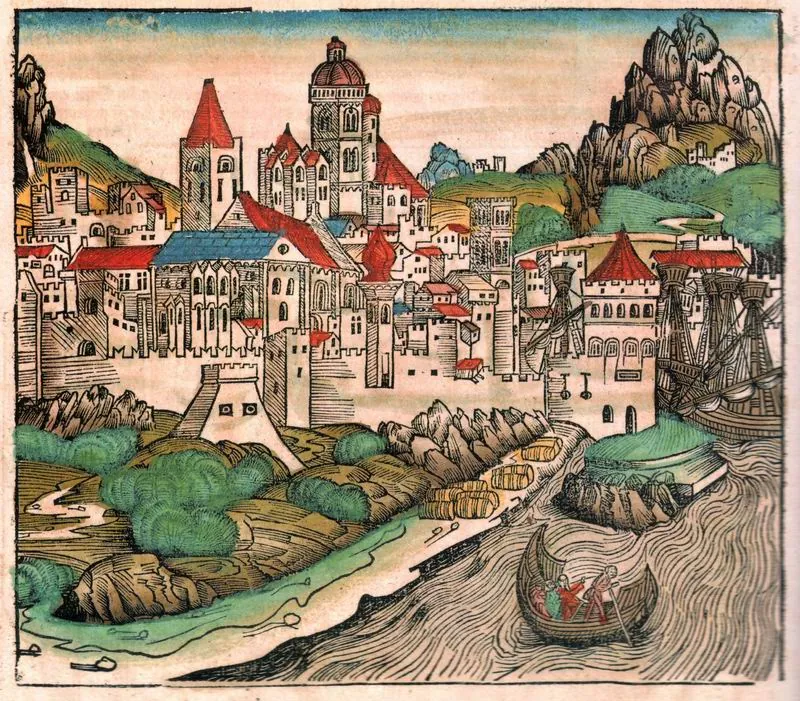
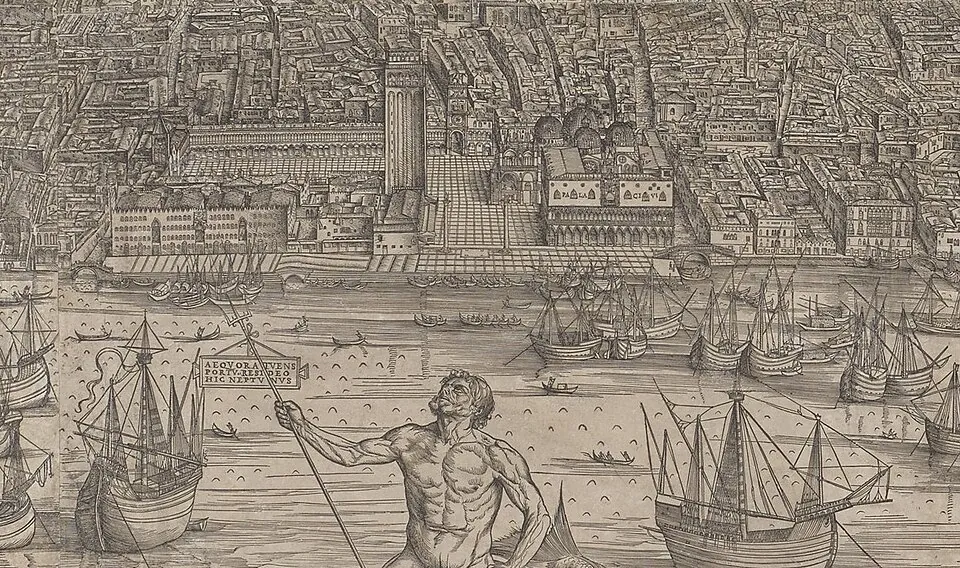
By 1467, a wealthy member of the family, Hayyim Rappe, was active in Mestre, near Venice (Italy), where he served as a collector of charity for the Jewish community of the Holy Land. By 1475, a Dr. Moses Rap was prominent enough in Venice to be exempted from wearing the Jewish badge required of his neighbours. The family had clearly arrived, and arrived well.
The element Rapa (or Rappe) has two plausible origins. The most widely cited derives the name from the Middle High German Rappe, meaning a raven — a connection reinforced by the bird that has appeared on the family coat of arms ever since. A second tradition, recorded in some rabbinic sources, links it to the Hebrew rofeh, meaning physician, which would befit the medical profession that several early bearers practised.
The Town of Porto§
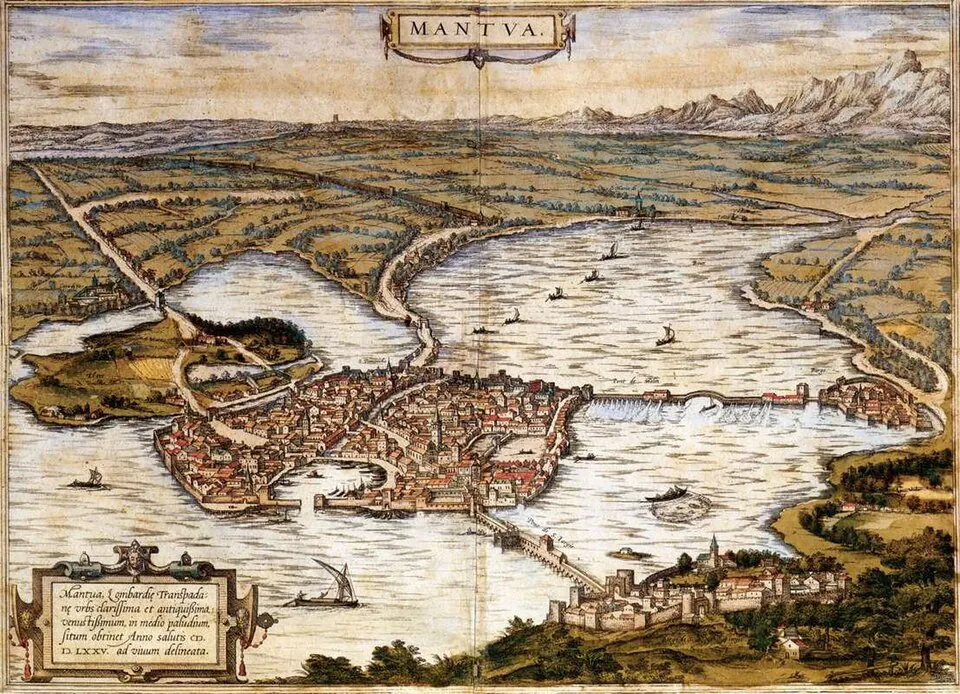
The second half of the name comes from a small town in the province of Mantua, in Lombardy, Italy — Porto, today usually called Porto Mantovano. This is a point worth emphasising, because the surname is sometimes mistakenly traced to Oporto in Portugal or to Fürth in Bavaria. The Italian Porto, set on the lakes south of Lake Garda, is the true source.
In 1540, a Rabbi Isaac Porto ha-Kohen received permission from the Duke of Mantua to build an Ashkenazi synagogue there, and the Porto family took its name from the town. A generation later, a marriage alliance — or, by another account, a deliberate act of distinction by one prominent rabbi — combined the two surnames into a single hyphenated form: Rapa-Porto, which over time fused into Rapoport, Rappaport, and ultimately Raperport.
The most influential figure of this Italian period was Rabbi Abraham Menahem ben Jacob ha-Kohen Rapa of Porto (d. 1596). A scholar, physician, proofreader of Hebrew books in Venice, and rabbi of Cremona (Italy), he was the author of Minhah Belulah, a commentary on the Pentateuch, and several other works. He witnessed the burning of the Talmud in Italy in 1553 following a papal decree, and observed the anniversary as a personal fast for the rest of his life. It was largely through his branch of the family that the combined surname became fixed — see section VI for how a descendant line of the same family reaches Poznań (Poland) only a generation or two later.
A Priestly Lineage§
The Raperport family belongs historically to the Kohanim — the priestly clan in Jewish tradition, descended by patrilineal line from Aaron, brother of Moses. Kohanim retain ceremonial roles in the synagogue to this day, including the priestly blessing performed with hands raised in a distinctive gesture (see the Glossary for related terms).
This priestly identity is a defining feature of the family's historical self-understanding, although it is important to note that not every modern Raperport will be a Kohen. Over the centuries the name was sometimes adopted, inherited through women, or taken by families seeking to associate themselves with its rabbinic prestige. So while the Kohenite tradition runs strongly through the family's history, individual lines vary.
The Crest: A Raven and Two Hands§
Few rabbinic families of the early-modern period carry a more enduring visual signature than the Rapa-Porto. The crest reproduced here — a heraldic raven beneath two hands raised in the priestly blessing, set within a circular medallion supported by two classical figures — has appeared on printed books, marriage contracts, and gravestones across the family's diaspora for more than four hundred years.
The version that has come down to us is taken from the 1594 escutcheon of Rabbi Abraham Menahem ben Jacob ha-Kohen Rapa of Porto (d. 1596), printed as a frontispiece to his Minhah Belulah at Verona (Italy). The Hebrew inscription above the medallion names the rabbi as Avraham Menahem ha-Kohen; the inscription below names him Rapa mi-Porto — Rapa of Porto. The design served thereafter as both a personal printer's mark and a family arms.
Versions of the same design circulated widely. A copy is preserved among the heraldic collections of Spain; engraved variations appear on Italian, Polish, and Galician Rapoport headstones into the 19th century; and the imagery was taken up by the 19th-century scholar Eliakim Carmoly for his 1861 genealogical study of the family, Ha-Orevim ve-ha-Yonah ("The Ravens and the Dove") — a title that quietly nodded to both the family's heraldic raven and the doves that figured in the seals of related rabbinic houses.
For the line traced specifically on this page, the crest is a continuity that runs unbroken from the printed page of 1594 Verona to the page you are reading: it has accompanied the family across Mantua, Poznań, the Lithuanian villages, Warsaw (Poland), and finally Whitechapel (England), and it remains the surest single emblem of belonging to the Rapa-Porto family.